
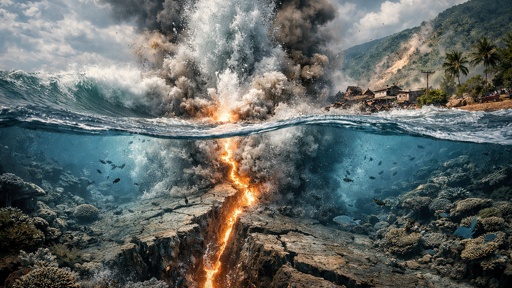
Over 200 earthquakes have rattled the Puerto Rico Trench in recent months, and scientists are closely watching whether this unprecedented swarm signals the awakening of one of the Atlantic’s most dangerous fault zones.
The Atlantic’s Sleeping Giant Stirs
The Puerto Rico Trench sits at the boundary where the North American Plate grinds beneath the Caribbean Plate at roughly 20 millimeters per year. This subduction zone, located at coordinates 19°50′9″N 66°45′16″W, creates the Atlantic Ocean’s deepest point and generates a complex web of compression, extension, and strike-slip faults. The recent earthquake swarm initiated in December 2025 with hundreds of magnitude 4 to 5 events, then escalated through March 2026 with a magnitude 5.0 quake on March 31. By early April 2026, seismic activity continued spreading across approximately 100 miles of the trench.
What makes this swarm noteworthy is its persistence and geographic distribution. Unlike isolated tremors, these earthquakes cluster along multiple segments of the trench, suggesting what some analysts call system reorganization. The shallow depth of many events, around 10 kilometers offshore, amplifies potential risks to nearby populations. Puerto Rico, the U.S. Virgin Islands, and the British Virgin Islands sit directly in harm’s way, while some observers warn of potential impacts reaching the U.S. East Coast should a major earthquake generate a significant tsunami.
Echoes of Past Disasters
The 1918 San Fermín earthquake, measuring magnitude 7.2 to 7.5, generated a destructive tsunami that slammed into Puerto Rico’s coast. That event remains the region’s benchmark for catastrophic seismic potential. More recently, the 2019-2020 swarm began on December 28, 2019, and produced over 500 earthquakes measuring magnitude 2 or higher. The sequence peaked with a magnitude 5.8 on January 6, 2020, followed by a magnitude 6.4 the next day. Those quakes caused structural damage, collapsed the iconic Punta Ventana rock formation, triggered one death, and prompted a state of emergency declaration.
Despite the intensity of the 2020 events, no major tsunami materialized. The Caribbean Tsunami Warning Program issued and then canceled alerts as officials monitored wave activity. Power infrastructure took severe hits, leaving 300,000 homes without water and causing widespread blackouts. The contrast between 2020’s substantial damage and the absence of a significant tsunami illustrates both the region’s vulnerability and the uncertainty surrounding tsunami generation in this complex tectonic environment. Tourism and energy sectors absorbed economic losses, while political leaders faced pressure to upgrade infrastructure resilience and emergency preparedness systems.
The Science Behind the Swarm
Seismologist Cindy Mora-Stock describes the Puerto Rico region as a complex rotational dance of tectonic plates. The area experiences northern subduction at the Puerto Rico Trench, southern subduction activity, and mid-island strike-slip faulting. Recent earthquakes register as oblique strike-slip events at approximately 10 kilometers depth, which so far carries low tsunami risk according to official assessments. The United States Geological Survey and the Puerto Rico Seismic Network provide real-time data tracking swarm locations, magnitudes, and patterns. The National Weather Service’s Caribbean Tsunami Warning Program evaluates whether individual events warrant public alerts.
Independent analysts including YouTube geologist TheEarthMaster have highlighted the swarm as potentially signaling larger events ahead. TheEarthMaster references historical patterns in subduction zones where prolonged swarms preceded major earthquakes, warning of potential magnitude 8+ events and East Coast tsunami threats. These perspectives contrast sharply with official positions. Government seismologists emphasize monitoring over speculation, noting that swarms can represent harmless strain release rather than precursors to catastrophe. The divergence between alarmist interpretations and measured scientific assessments reflects genuine uncertainty about what these earthquakes mean for future hazards.
What Happens Next
The immediate concern focuses on continued monitoring as the swarm remains active. Short-term risks include additional power outages, structural damage to buildings not built to seismic codes, and localized tsunami alerts similar to those issued in 2020. Long-term implications depend on whether locked portions of the fault remain capable of generating the magnitude 8+ earthquakes some analysts consider possible based on the trench’s tectonic capacity. Puerto Rico and the U.S. Virgin Islands represent American territories where federal disaster response obligations apply, yet infrastructure and monitoring systems reveal gaps exposed by past events.
The sensational headlines warning of panicking scientists and imminent mega-quakes lack support from named experts in official positions. What remains factual is the trench’s demonstrated tsunami potential from the 1918 event, the 2020 swarm’s documented impacts despite producing no major tsunami, and the current swarm’s unusual persistence across multiple fault segments. Common sense suggests Puerto Rico residents and East Coast communities should maintain awareness of official warnings from USGS and the Caribbean Tsunami Warning Program rather than relying on speculative YouTube content. Preparedness beats panic, and the data shows this story continues to unfold without reaching any definitive conclusion about whether a major earthquake approaches or these swarms simply release accumulated strain harmlessly over time.
Sources:
Puerto Rico Trench – Wikipedia
Puerto Rico earthquake: Tsunami alert issued as powerful tremor causes blackouts – The Independent
Rare Earthquake Swarm Strikes Puerto Rico – Eos
Multiple Earthquakes Rock Puerto Rico: No East Coast Tsunami Threat – WeatherBoy
URI Digital Commons – Ocean Engineering Faculty Publications