
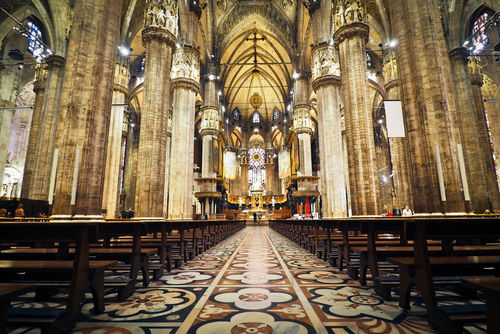
A Catholic priest in Spain followed his Church’s rules on Holy Communion — and ended up facing a police complaint and street protests for it.
Quick Take
- Two men in a same-sex civil marriage in Seville, Spain, were denied Communion by their priest, who cited Catholic teaching on marriage.
- The couple filed a police complaint, and LGBTQ+ advocacy groups called the refusal “discriminatory and unjust.”
- Catholic canon law gives priests the authority to withhold Communion from those in public situations the Church considers incompatible with receiving the sacrament.
- Similar cases have occurred in the U.S. and Europe over the past decade, showing this is a recurring conflict between Church discipline and civil rights claims.
What Happened in Seville
In June 2024, a priest in the Archdiocese of Seville refused to give Holy Communion to two men who were married under Spanish civil law. The couple then reported the priest to the police. The LGBTI Andalusian Federation and a group called Andalusia Diversity publicly condemned the refusal, calling it “clearly discriminatory and unjust.” The incident quickly drew media attention and reignited a debate that has played out in Catholic parishes across the Western world for years.
This was not an isolated event. A nearly identical situation unfolded in Montana in 2014, when a new priest told a gay couple they could no longer receive Communion after learning they had been married in a civil ceremony. A Michigan Catholic church denied Communion to a state district court judge because she was married to a woman. A Washington, D.C.-area priest refused Communion to a woman at her own mother’s funeral. These cases span more than a decade and multiple countries, pointing to a deep and unresolved tension inside the Church itself.
What Church Law Actually Says
Catholic canon law — specifically Canon 915 — states that those who are “obstinately persevering in manifest grave sin” should not be admitted to Holy Communion. The Eternal Word Television Network (EWTN), a major Catholic media outlet, cites this canon to support denying Communion to those in active same-sex relationships. The Church does not recognize same-sex civil marriages as valid sacramental unions. From the Church’s point of view, a priest who follows this rule is doing his job, not committing an act of discrimination.
However, the picture is more complicated than that. America magazine, a respected Catholic publication, warns that priests cannot automatically assume someone in a same-sex civil marriage is in a state of “manifest grave sin.” The magazine argues that a minister may actually be obligated to share the Eucharist in some such cases. The Church’s own Catechism also draws a clear line between homosexual acts and homosexual orientation, stating that orientation alone cannot be treated as sinful. That distinction matters when a priest decides whether to withhold the sacrament.
A Conflict That Goes Beyond Religion
What makes this story bigger than one church in one Spanish city is what it reveals about competing ideas of authority, rights, and belonging. On one side, many Catholics — and many Americans who share traditional religious values — believe a church has the right to enforce its own rules. They see the police complaint and the street protests as an attack on religious freedom. If a priest cannot follow his Church’s teaching without being hauled before law enforcement, that is a threat to something fundamental.
On the other side, LGBTQ+ advocates and their supporters argue that being turned away at the altar in front of other worshippers is a form of public humiliation. They frame the denial not as doctrinal discipline but as targeted exclusion. Both sides are speaking a language of rights — one rooted in religious liberty, the other in equal treatment. That clash is not going away. And as long as civil governments and religious institutions define marriage differently, priests will keep facing this exact moment, and communities will keep dividing over it. The deeper question — who gets to decide who belongs — is one no police report or protest sign is going to settle.
Sources:
[1] Web – Faithful priest targeted by protesters after denying ‘married’ …
[2] Web – Montana gay couple denied Communion after marriage
[3] Web – Priest Denies Eucharist to Married Gay Couple and They Report …
[4] Web – Another Gay Person Is Denied Communion at a Parent’s Funeral
[5] Web – Priests should think twice before denying Communion to Catholics …
[6] YouTube – Gay judge denied communion at Catholic Church in Grand Rapids
[7] Web – Denying Communion to Someone | EWTN
[8] Web – Catholic priest denies communion to LGBTQ+ individuals – Facebook
[9] Web – D.C. Area Priest Who Denied Communion to Lesbian at Mother’s …
[10] Web – Catholic diocese denies gay Michigan judge communion – WXYZ
[11] Web – Lewistown Gay Couple Denied Communion After Marriage
[12] Web – Should a gay couple be allowed to take holy communion? – Facebook
[13] Web – Faith Leaders Respond to Catholic Priest’s Denial of Communion to …
[14] Web – Catholic Church and homosexuality – Wikipedia
[15] Web – Information for Gay & Lesbian Catholics