

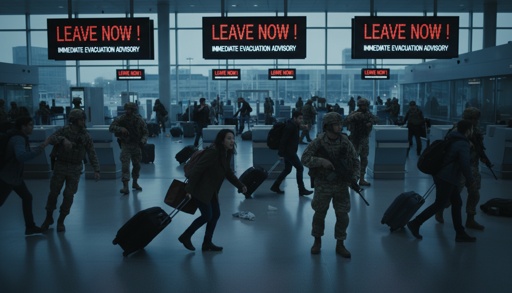
On one of the busiest travel weekends of the year, a single unattended bag at Miami International Airport was enough to clear terminals, halt flights, and remind travelers how quickly “security” decisions by distant authorities can upend ordinary Americans’ lives.[5][1]
Story Snapshot
- Authorities evacuated parts of Miami International Airport after unattended luggage was reported near a departures door, triggering a bomb squad response and checkpoint closures.[5][3]
- Officials later gave an all-clear, but only after hours of disruption, flight delays, and cancellations during peak holiday travel.[5][1]
- Airport policy treats any unattended item as a potential threat, reflecting a “evacuate first, explain later” approach that leaves the public in the dark.[3]
- Both conservatives and liberals see episodes like this as more evidence that ordinary travelers bear the costs of a security bureaucracy that rarely answers for overreach or failure.[1][5]
What Actually Happened at Miami International Airport
On Sunday evening, Miami-Dade Sheriff’s Office deputies were called to Miami International Airport after a report of unattended luggage near Door 21 in the South Terminal departures area.[5][3] Deputies identified the bag and, “out of an abundance of precaution,” ordered everyone in the area evacuated while the bomb squad responded.[5] Airport spokesperson Greg Chin confirmed that Transportation Security Administration checkpoints serving Concourses G, H, and J, along with the curbside roadway, were shut down as law enforcement secured the scene.[5][1]
During this period, passengers were moved out of sections of the terminal, and access to multiple security checkpoints was cut off.[5][1] Reports described travelers being sent outside or away from the departures level while officers assessed the item as a possible explosive threat.[1][3] The disruption unfolded during a high-demand travel window, magnifying the impact on families, workers, and businesses already stretched by crowded flights, tight schedules, and lingering frustration over travel costs and reliability.[1]
From “Potential Threat” to All Clear — With Little Explanation
Authorities later reported that the bomb squad completed its inspection and issued an all-clear around 7:40 p.m., allowing normal operations to resume.[5] No public statement detailed what, if anything, was actually inside the luggage, whether it was simply abandoned property, or whether any person was identified as responsible.[5][3] Coverage consistently framed the episode as a “potential security threat” or “bomb scare,” even though the available record shows a precautionary response, not confirmation of a device or plot.[1][4]
Miami International Airport’s own security rules instruct travelers to report any unattended items or suspicious behavior immediately to airline staff or to the Miami-Dade Sheriff’s Office Airport Operations Bureau.[3] That policy means an unclaimed bag is enough to trigger a cascade: law enforcement notification, checkpoint closures, bomb-squad deployment, and in some cases wide-area evacuation.[3] Emergency management doctrine generally favors this “mitigation first” posture, prioritizing quick isolation of a potential hazard over the risk of later being accused of underreacting.
Holiday Travelers Caught Between Safety and Systemic Overreach
For the public, these protocols translate into hours of uncertainty, missed connections, and financial losses, often with almost no information beyond a loudspeaker announcement about a “suspicious item.”[1][5] One secondary account claimed that roughly 148 departures were canceled and more than 180 delayed as the scare rippled through Miami’s schedule, underscoring how a single security event at a hub airport can disrupt domestic and international travel for thousands.[1] Whether each cancellation directly tied to this incident or to broader congestion, passengers paid the price while decision makers faced little accountability.
Travel Alert – United States of America (🟢Risk) – Miami Airport briefly evacuated following security threat – Closed. Police indicated that the evacuation of the north and central terminals at Miami International Airport (MIA/KMIA) during morning hours local time was prompted by…
— Rennies BCD (@RenniesBCDZA) May 25, 2026
Episodes like this resonate with frustrations across the political spectrum. Conservatives see another example of a sprawling security state that can instantly interfere with commerce and mobility, yet rarely answers for false alarms, waste, or mission creep.[1] Liberals see working families and lower-income travelers absorbing the costs in lost wages, childcare issues, and rebooked flights while large institutions and airlines move on.[1][5] Both sides can agree that a system that regularly upends plans without transparent explanation feels less like service and more like control.
Security Protocols, Public Trust, and the “Deep State” Question
Miami’s response largely followed the script that has evolved over two decades of heightened aviation security: evacuate first, close access, deploy specialized units, then offer brief statements once the incident is over.[3][5] Officials emphasize that if a bag turned out to contain a real device, the public would demand to know why tougher steps were not taken. However, the flip side is a pattern in which every precautionary move is presented as proof of danger, while the absence of detailed follow-up reporting leaves a vacuum easily filled by speculation and distrust.[1][4]
For citizens already convinced that federal and local institutions serve their own interests first, this Memorial Day disruption fits into a larger story. Travelers watched heavily armed teams, flashing lights, and closed doors, but received almost no concrete information about risk, findings, or lessons learned.[4][5] Without routine release of incident reports, after-action reviews, or clear metrics for when evacuations are truly necessary, people are left to wonder whether the system is calibrated for their safety or for the comfort and liability protection of those in charge.
What This Incident Reveals About Governance and Accountability
When a single unattended bag can paralyze part of a major airport at a critical travel moment, it exposes how fragile everyday life has become under complex, centralized systems.[1][5] Aviation security must contend with real threats, yet the burden of every disruption falls on ordinary people trying to attend graduations, funerals, and family gatherings. The agencies that make the calls rarely explain how they weigh costs and benefits, or what changes after each scare to make the next disruption less severe.
Americans on both the right and the left increasingly see a pattern: powerful institutions act swiftly when it protects their own liability or reputation but move slowly when transparency or reform might reduce their control. The Miami incident will likely fade from headlines, but for stranded passengers, it was another reminder that the modern security state can upend their plans in minutes and answer their questions—if at all—only after the damage is done.[1][5]
Sources:
[1] Web – Potential security threat at Miami International Airport leads to …
[3] Web – MIA Airport Security
[4] Web – Potential security threat reported at Miami International Airport
[5] YouTube – BREAKING: Miami International Airport Evacuated