

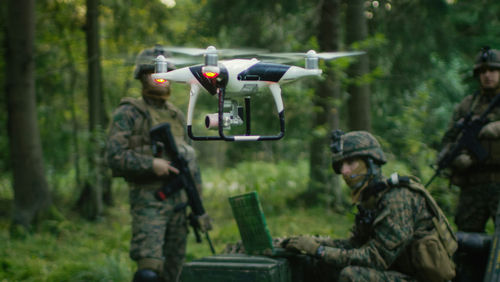
A nuclear‑armed U.S. base is racing to buy “drone guns” because cheap enemy quadcopters are now a real homeland threat.
Story Snapshot
- The U.S. Air Force is moving fast to buy Dronebuster Block 4 anti‑drone “guns” for a nuclear‑strike base at Minot Air Force Base in North Dakota.[1][2]
- These handheld jammers let a single defender point, pull the trigger, and disrupt a hostile drone’s control and navigation links instead of firing bullets over American soil.[1][2][13]
- Dronebuster is already fielded across the military and is the only handheld electronic attack jammer formally authorized for U.S. use, but some Army leaders say past versions perform poorly.[2][7][13][15]
- Exploding drone swarms in Ukraine and the Middle East show how low‑cost drones could target U.S. bombers, missile fields, or even civilian critical infrastructure if defenses lag.[1][11][21][23]
Air Force Rushes Dronebusters To Guard A Nuclear‑Strike Base
At Minot Air Force Base in North Dakota, the 5th Contracting Squadron has issued a June 18, 2026 solicitation to buy DZYNE Technologies’ Dronebuster Block 4 handheld counter‑drone systems for the 91st Security Forces Group, which guards nuclear‑strike assets and B‑52H bombers.[1][2] The Air Force labeled the purchase an “operational necessity” and gave industry less than two weeks to respond, underscoring growing concern that low‑cost drones could threaten nuclear infrastructure inside the United States.[1][2][6]
The Dronebuster Block 4 is a rifle‑shaped electronic warfare device that a single airman can carry without vehicles, generators, or large power sources.[1][2][8] The operator points it at an unauthorized drone and uses focused radio‑frequency energy to break the control link or satellite navigation, forcing the drone to return, land, hover, or crash instead of reaching the protected site.[1][13] Vendor and Air Force materials describe it as the only handheld electronic attack system authorized for U.S. military use, reflecting years of fielding across multiple installations.[2][6][12][13]
What The Dronebuster Can And Cannot Do Against Modern Drones
Dronebuster was designed to defeat common “off‑the‑shelf” quadcopters and modified hobby drones that rely on industrial, scientific, medical, and ham radio bands, plus global positioning satellite signals, for control and navigation.[3][13][20] Handheld jammers like this typically reach one to two kilometers, enough to cover a base perimeter or a missile field access point when used by roaming patrols.[3][8][13][28] Because the system is non‑kinetic, it avoids stray bullets or debris over local towns, which matters when defending domestic nuclear and high‑explosive sites.[6][24][26]
However, the same reports and commentary warn about hard limits. The Dronebuster works by attacking radio and satellite links, so it is far less useful against next‑generation drones that fly by pre‑programmed routes or use fiber‑optic tethers instead of radio control.[1] In those cases, jamming may do little, which is why analysts argue handheld jammers must sit inside a “layered” defense that also uses radar, smart scopes, missiles, or even high‑power microwaves to stop tougher threats.[21][22][23][24][28] The Air Force move at Minot fits this pattern: Dronebuster adds a cheap layer, not a magic shield.
Mixed Reviews From The Field And The Push For Better Gear
Public records show the Air Force first bought 100 Dronebuster Block 3 units in 2017 as an off‑the‑shelf answer to rising small‑drone threats.[3][13] The Army’s rapid equipping offices also fielded Dronebuster Block 3 devices for use against terrorists and on overseas bases, and military photos and reports show troops training with the handheld jammer in Europe and the Middle East.[4][11][16][17] The manufacturer says more than 3,000 units of the family have been delivered worldwide and claims effectiveness against both basic and modified commercial drones.[12][20]
Yet not everyone in uniform is impressed. Army Secretary Dan Driscoll recently told soldiers at Fort Drum that the Dronebuster was “f*cking terrible” in his experience, criticizing the handheld jammer after years of use by units, including on patrols along the southern border.[7][15][19] His remarks came as infantrymen in Italy were still training on the newer Dronebuster Block 4 variant, showing that the Army is testing upgrades even while its top civilian questions how well earlier versions perform under combat conditions.[7][15][22] That tension between urgency and proof is driving calls for tougher testing and faster replacement of underperforming gear.
Why Handheld Jammers Matter For Homeland Defense And Civil Liberties
Across the services, spending on small jammers is rising because the battlefield has changed. The spread of cheap drones in Ukraine, the Middle East, and other hot spots has convinced planners that any base, convoy, or fuel farm could face surveillance or kamikaze quadcopters.[1][11][21][23] The Army alone sought $13.5 million in the 2025 budget for handheld anti‑drone devices, including 20 Dronebusters, and billions more are going into backpack, vehicle, and shipboard jammers as part of a wider push for “spectrum dominance.”[21][22][23][28] Minot’s request is one small piece of that much larger shift.
USAF Seeks 'Dronebuster' Anti-Jammer Gun To Protect Nuclear-Strike Base https://t.co/f2a3k8hdg2
— zerohedge (@zerohedge) June 22, 2026
Inside the United States, however, the government’s use of jammers is tightly controlled. Under the Communications Act, it is generally a federal crime to operate radio‑frequency jamming gear unless you are an authorized agency, and recent guidance under the SAFER SKIES Act keeps those powers in the hands of the military, federal security services, and a narrow group of trained state and local law enforcement units.[25][26] That legal wall means law‑abiding citizens and private sites cannot legally field their own “drone guns,” so they depend on the federal government to protect nuclear bases, critical infrastructure, and the airspace overhead.[25][26]
Sources:
[1] Web – USAF Seeks ‘Dronebuster’ Anti-Jammer Gun To Protect Nuclear-Strike …
[2] Web – 91st SFG Dronebuster – Bid Banana
[3] Web – Power Up to Dronebuster® Block 4 with Next-Generation Counter …
[4] Web – DZYNE Introduces Dronebuster 4-EU, Secures Multi-Million-Dollar …
[6] Web – Power Up to Dronebuster® Block 4 with Next-Generation Counter …
[7] Web – Dronebusters – HigherGov
[8] Web – Purchase Order FA442725P0019 – GovTribe
[11] Web – DZYNE launches Dronebuster upgrade programme
[12] Web – US Army Tests Portable ‘Dronebuster’ in Middle East
[13] Web – DZYNE Dronebuster DB4 – Compact Counter-UAS System
[15] Web – Dronebuster 3B is a handheld device that disables drones using RF …
[16] Web – Army secretary says the Dronebuster is ‘f*cking terrible’ as soldiers …
[17] Web – Video – Dronebuster class B-Roll – DVIDS
[19] Web – Dzyne Technologies introduces lightweight Dronebuster DTIM kit for …
[20] Web – Army secretary says the Dronebuster is ‘f*cking terrible’ as soldiers …
[21] Web – Dronebuster: NEWCOM is an Authorized Distributor of DZYNE
[22] Web – Army aims to equip a division with hand-held counter-drone gear
[23] Web – Challenges and strategies in equipping military divisions with hand …
[24] Web – Military Jammer Market Size ($10.9 Billion) 2030
[25] Web – 10 Anti-Drone Weapons Used By The U.S. Military (2026 Update)
[26] Web – Buyer’s Guide To Counter UAS And Drone Jamming Systems
[28] Web – The U.S. Marine Corps just bought British NightFighter Mini drone …