
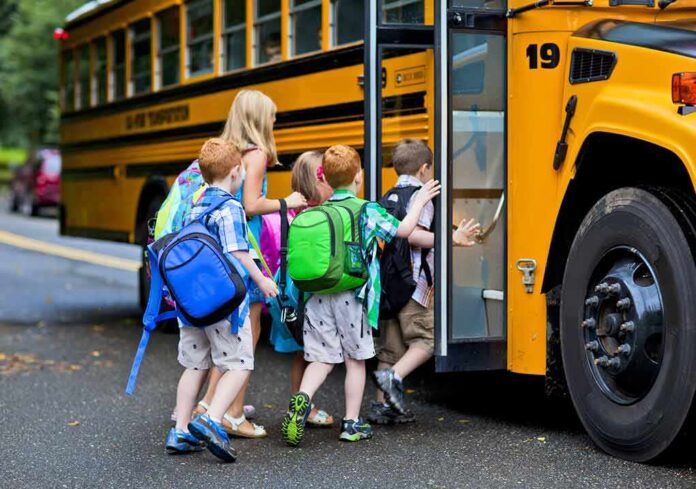
The important fact is not just that a school bus hit a pharmacy in Parkville; it is that a bus carrying students from the Maryland School for the Blind ended up fully inside a building, which is why the incident immediately became a public-safety event rather than a routine traffic crash. The core event is well supported, but the precise injury count and the exact characterization of the struck structure are still uneven across early reports.
Key Points
- Local and national reporting consistently identify the bus as carrying students from the Maryland School for the Blind.
- The crash is placed in Parkville, Baltimore County, near Harford Road, with multiple reports saying the bus entered the building.
- People were injured and transported, but early casualty counts vary across outlets.
- The cause has not been determined; officials say the crash remains under investigation.
What is firmly established
The backbone of the story is straightforward. A school bus transporting Maryland School for the Blind students crashed in Parkville and struck a building at or near 7816 Harford Road; several accounts describe the bus as ending up completely or fully inside the structure. That is not a marginal detail. When a bus passes through a storefront wall and comes to rest in a commercial building, responders must treat the scene as both a transportation incident and a structural-safety problem, which explains the delayed removal of the vehicle while engineers assessed the building.
The injury picture is also clear at the broad level: there were multiple minor injuries and hospital transports, including children and adults. CBS Baltimore reported that a child and two adults were taken to hospital with minor injuries, while other sources noted additional people evaluated at the scene and not transported. Those are compatible descriptions of the same event, but they are not identical tallies, and that distinction matters if one is trying to reconstruct the incident with precision rather than merely understand its significance.
Why the exact numbers still wobble
Early incident reporting often moves faster than the official record, and this crash is a textbook example. One outlet reported three students and two adults aboard the bus, with the driver, a student, and another man suffering minor injuries. Another reported two adults and one child hospitalized, plus eight people evaluated at the scene. CBS Baltimore described a child and two adults hospitalized and eight more evaluated, while other summaries varied in how they framed the transported versus evaluated totals. The public should read those differences as a sign that the incident was still being sorted, not as evidence that the core event is in doubt.
That distinction is important because the available material is dominated by newsroom accounts of official briefings, not the underlying police crash report, fire incident report, EMS run sheets, or a full school statement. In practice, that means the broad narrative is solid, but the granular facts are provisional. The exact number of people on board, the exact number treated, and the exact status of each injured person remain the sort of details that can shift once the incident record is reconciled.
What the reports do and do not say about cause
The most important unanswered question is also the most basic one: why did the bus leave the roadway and strike the building? On that point, the record is deliberately thin. Reporters say the crash was under investigation, and officials declined to provide more detail while that work was ongoing. That means no confirmed finding yet on driver error, mechanical failure, weather, roadway conditions, or any medical event. Anything beyond that would be speculation, and the available reporting does not support speculation as fact.
There is one contextual clue, but it should not be overread. WJZ’s account says the investigation was hampered by severe weather, including heavy rain, thunder, and lightning. That tells us the response and investigation were complicated by conditions at the scene; it does not establish weather as the cause. In crash analysis, that distinction is fundamental. Weather can reduce visibility, lengthen braking distance, or complicate control, but none of those possibilities becomes a finding until investigators connect them to the vehicle’s actual path, speed, and condition.
Why this crash drew so much attention
Several features made the Parkville incident feel more serious than a typical bus collision. First, the passengers were students from the Maryland School for the Blind, which understandably sharpens public concern and demands careful handling from responders and school officials. Second, the vehicle came to rest inside a building rather than beside the roadway, giving the crash a rare, almost cinematic severity. Third, the scene required coordination among police, fire, EMS, and building-safety personnel, because the immediate question was not only who was hurt, but whether the structure itself could remain standing safely.
The Maryland School for the Blind did issue a statement acknowledging the crash and thanking emergency personnel for their response, according to WJZ. That matters because it confirms institutional awareness and response, even though the public material does not include the full text of the statement. In incidents involving vulnerable passengers, the school’s role is not peripheral; it is part of the public accountability chain, especially when transportation is contracted and operating responsibility may sit with a separate provider or district arrangement.
Several people were taken to area hospitals after a school bus carrying students from the Maryland School for the Blind crashed into a building in Parkville on Tuesday afternoon, prompting emergency crews to declare a mass casualty incident.
The crash happened shortly after 2:40… pic.twitter.com/aXVYk4gTXI
— The Baltimore Sun (@baltimoresun) July 21, 2026
What remains unresolved in the public record
Three gaps still define the case. The first is causation: investigators have not publicly assigned a reason for the crash. The second is vehicle governance: one report says the bus was contracted by Baltimore County Schools, but the public excerpt does not spell out the operator, maintenance responsibility, or route assignment. The third is the structural and occupancy detail of the building itself. Some reports call it a pharmacy, while others use broader language such as business or building, so the exact tenant identity is not yet fully consistent across the available coverage.
That is why the correct reading of this event is disciplined rather than sensational. The crash itself is established; the severity is established; the fact of injuries is established. What is not established is the mechanism that produced it. In transportation incidents, that is where serious analysis starts, not ends. Until the primary records appear, the most responsible conclusion is the simplest one: a school bus carrying Maryland School for the Blind students crashed into a Parkville building, several people were injured, and the cause remains officially unresolved.
Sources:
nypost.com, foxbaltimore.com, newsbreak.com