
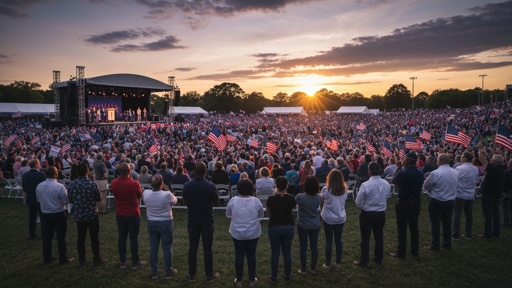
Thunder and lightning forced a mass evacuation at President Trump’s historic Salute to America 250 — and exposed how big-government planners still struggle to protect crowds without sowing chaos.
Story Snapshot
- Official safety partners ordered an immediate evacuation of the National Mall due to severe storms and lightning.
- Freedom 250 and federal agencies coordinated shelter sites, but confusing directions and full buildings left many patriots scrambling.
- D.C. Fire and emergency medical services treated dozens for heat and storm-related issues, confirming real health risks.
- President Trump rejected calls to cancel, praised law enforcement for fast re-screening, and went ahead with his speech and record fireworks.
Evacuation Order Hits Trump Crowd Just Before Celebration
Freedom 250 event officials issued a firm evacuation order around 7:00 p.m., telling thousands on the National Mall to leave the grounds because of approaching thunderstorms and lightning. The announcement said the decision was made with the National Capital Safety Planning Committee and public safety partners, including the United States Secret Service and United States Park Police. Attendees were told to stay calm, follow law enforcement, and exit the secured area so the storm could pass without mass injuries or deaths.
Organizers first directed people to seek shelter in white tents at the back of the event, then shifted to named buildings as the storm threat grew. Announcers listed three refuge sites, including the African American Museum and the Ronald Reagan Building, as safe places to ride out the weather. Video from the scene shows event staff repeating that “for your safety” guests must evacuate immediately due to severe weather, underscoring that safety — not politics — triggered the move.
Real Safety Risks: Heat, Lightning, and Packed Shelters
Washington Post reporting describes triple-digit heat during much of the day, followed by darkening skies, lightning, and gusting winds hitting the Mall just after 7:00 p.m. D.C. Fire and emergency medical services transported 34 people to hospitals and treated 58 more on-site, many for heat-related problems, underlining why emergency planners were on high alert. These numbers show the risk was not theoretical; many attendees struggled with heat and storm conditions before fireworks ever launched.
Detailed local accounts say some crowd members refused to leave even as lightning flashed overhead and winds swept the area. That resistance made the job of police and medical teams harder and raised the chance that someone could be hurt or killed. At the same time, some shelters, including the Internal Revenue Service building, quickly reached capacity and had to turn people away. Organizers then pushed new directions on social media, pointing evacuees to other buildings like the Department of Education and Jefferson Memorial, revealing both planning efforts and real strain on available safe space.
Planning, Confusion, and Media Spin
Freedom 250 materials show planners had months of coordination with federal agencies, including the Federal Emergency Management Agency, to prepare for heat, storms, and security issues. They expanded cooling tents, hydration stations, and medical support and warned that schedule changes or evacuations would be announced if severe weather developed. This kind of pre-planning matches wider research that storms are the top cause of mass event disruptions worldwide, especially when extreme heat stacks on top of lightning risk.
Even with planning, the real-time evacuation still felt loud, hot, and chaotic to many on the ground. Major outlets, including The Washington Post and others, highlighted confusing directions about which buildings were open and reported that some sites stopped taking people, feeding a narrative of disorder. NBC and other media said many attendees had to rely on news reports for updates during sheltering, instead of clear official communication, which frustrated families who had braved the heat to see the President speak. That coverage risks painting the entire response as incompetence, while skipping over the fact that no violence was reported and the crowd was ultimately managed without major security breakdowns.
Trump Overrules Cancellation and Salute to America Continues
President Trump said he “personally overruled” a recommendation to cancel the event outright after the evacuation, choosing instead to delay and then restart once storms moved on. He later praised law enforcement and security teams for quickly re-screening those who wanted to return, with an estimated 150,000 people coming back through magnetometers to hear his speech and watch what organizers billed as a record-breaking fireworks show. This decision balanced real weather danger with a strong desire not to let America’s 250th birthday be washed out by fear or bureaucracy.
The White House’s broader America 250 plan frames the celebration as a major moment to honor the Declaration of Independence and the Constitution. For many conservatives, the fact that the event ultimately went forward — despite storms, heat, and media criticism — feels like a win for patriotism and resolve. At the same time, the night exposed gaps that still need work: clearer shelter directions, better capacity planning, and more direct communication that respects citizens as adults, not as problems to manage. As future mass events are planned, the lesson is simple: protect lives without trampling liberty, and do it with competence instead of confusion.
Sources:
facebook.com, youtube.com, aljazeera.com, apnews.com, scrippsnews.com